113
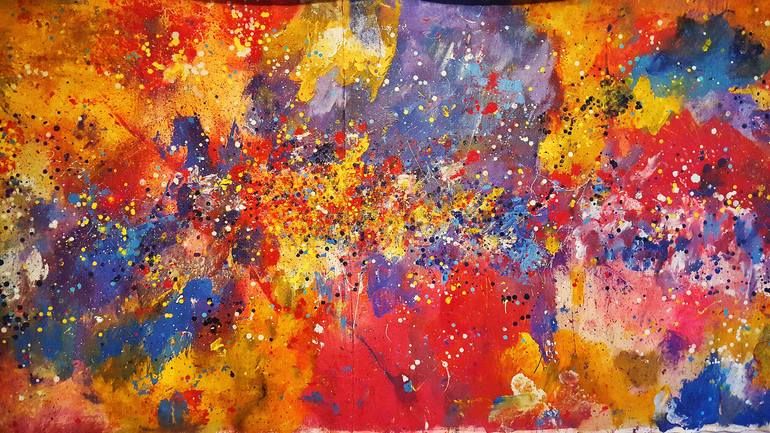
"Big Primary Outer Space Heartbeat" Painting
Painting, Acrylic on Canvas
411.5 W x 147.3 H cm
Ships in a Tube
This work will ship in a dent-resistant tube. Rolled works can easily be restretched. Read More
€30,048
Shipping Included
14-day satisfaction guarantee
Trustpilot Score
Artist Recognition
ABOUT THE ARTWORK
DETAILS AND DIMENSIONS
SHIPPING AND RETURNS
This is the longest piece of canvas I've ever worked on. Because of its weird dimensions, I knew it was best to paint in a horizontal field, which I'm not used to. My preferred method of working is on a vertical canvas on a wall. Although as I'm typing this, it does occur to me that what I consider...
Year Created:
2014
Subject:
Mediums:
Mediums:
Painting, Acrylic on Canvas
Rarity:
One-of-a-kind Artwork
Size:
411.5 W x 147.3 H x 2.5 D cm
Ready to Hang:
Not Applicable
Frame:
Not Framed
Authenticity:
Certificate is Included
Packaging:
Ships Rolled in a Tube
Delivery Cost:
Shipping is included in price.
Delivery Time:
Typically 5-7 business days for domestic shipments, 10-14 business days for international shipments.
Returns:
14-day return policy. Visit our help section for more information.
Handling:
Ships rolled in a tube. Artists are responsible for packaging and adhering to Saatchi Art’s packaging guidelines.
Ships From:
United States.
Need more information?
Need more information?
Louis Edward Love V
United States
Eddie Love is an American painter working under the umbrella of Postmodern Neanderthal Maximalism, a painting practice that combines prehistoric mark-making, graffiti, abstraction, advertising, music, and cultural archaeology. His paintings operate as maps without legends—layered systems of symbols, language, memory, and American mythology that reward repeated viewing rather than immediate explanation. Postmodern Neanderthal Maximalism is my attempt to describe a painting practice that begins where originality is often said to end. If postmodernism accepts that every image has already existed in some form, then the only way forward is backward—to the first mark, the first count, the first gesture made before language or theory. The “Neanderthal” is not a historical claim but a visual one. I deliberately embrace crude, childlike, heavy-handed mark-making: repeated hash marks that recall the earliest systems of counting, instinctive symbols, graffiti, and gestures that feel unearthed rather than designed. Saturated pigments and fluorescent color collide with this primitive vocabulary, as though prehistoric cave painting had encountered contemporary visual culture. The “Maximalism” comes from accumulation. I work until the painting becomes materially dense, layering symbols, language, memory, advertising, music, and American mythology into a surface that resists a single reading. The image refuses emptiness. Every session adds another archaeological layer. The work does not end at the front of the canvas. Paint continues across the edges and onto the reverse, where a second image emerges. Every painting therefore exists as two interconnected works occupying a single object, inviting the viewer to move around it rather than consume it from a single fixed position.
Artist Recognition

Artist featured by Saatchi Art in a collection
Why Saatchi Art?
Thousands of
5-Star Reviews
We deliver world-class customer service to all of our art buyers.
Global Selection of Original Art
Explore an unparalleled artwork selection from around the world.
Satisfaction Guaranteed
Our 14-day satisfaction guarantee allows you to buy with confidence.
Support Emerging Artists
We pay our artists more on every sale than other galleries.