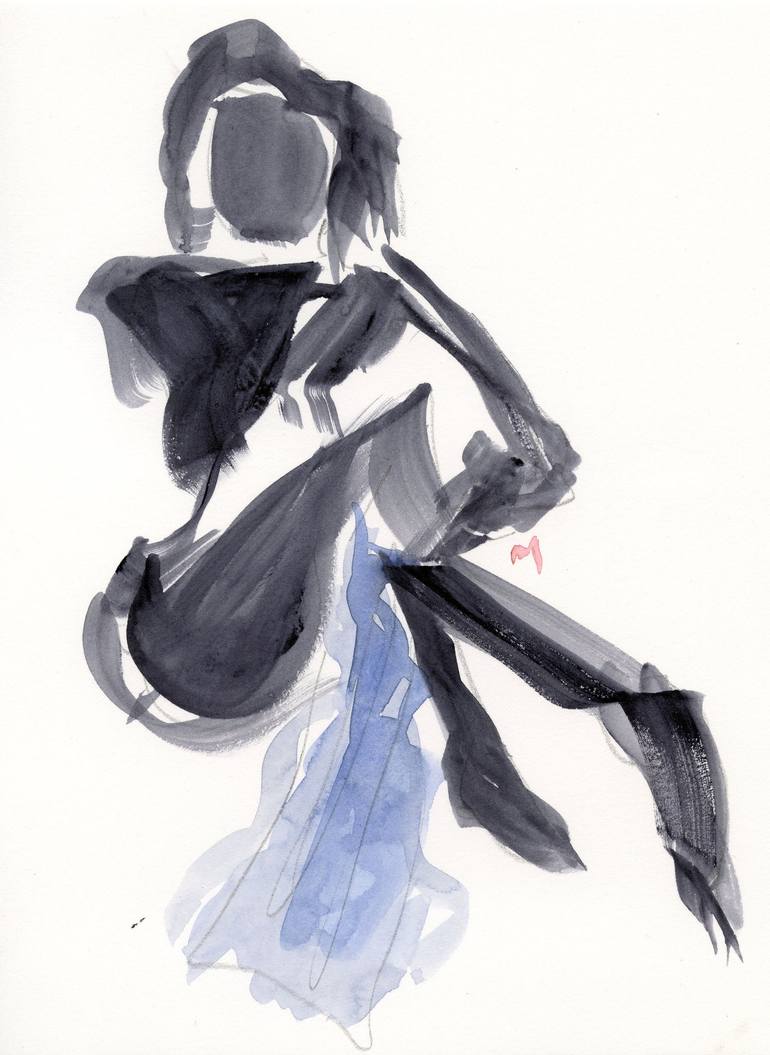

![A quickly done drawing, using graphite crayon and watercolour.
In the late 18th century, students in Jacques-Louis David's studio followed a rigorous program of instruction. Mastery in drawing was considered a prerequisite to painting. For about six hours each day, students drew from a model who remained in the same pose for one week.[5] "Eighteenth-century drawings, like that attributed to Jacques-Louis David, were usually executed on tinted paper in red or black chalk with white highlights and a darkened ground. The models' poses tended to be active: standing figures seem about to stir and even seated figures gesticulate dramatically. Close observation of the model's body was secondary to the rendering of his gesture, and many drawings - consistent with academic theory - seem to present a representative figure rather than a specific body or face. In comparison, academies produced in the nineteenth century [...] were typically executed in black chalk or charcoal on white paper and are meticulous depictions of the particularities and idiosyncrasies of the body of the live model. Evidence of the artist's hand is minimized and, although reclining or seated poses are rare, even standing poses are comparatively static..." [6] Before the late 19th century, women were generally not admitted to figure drawing classes.[7]
source: Wikipedia](https://images.saatchiart.com/saatchi/4532/art/7507403/additional_15264872f1273a751ff7e6d837fb319e1e480fc4-AICC2-22.jpg)
60 Views
49
View In My Room
Drawing, Graphite on Paper
Size: 15 W x 20 H x 0.1 D cm
Ships in a Box
$289USD
Shipping included
14-day satisfaction guarantee
Trustpilot Score
60 Views
49
Artist Recognition

Artist featured in a collection
ABOUT THE ARTWORK
DETAILS AND DIMENSIONS
SHIPPING AND RETURNS
A quickly done drawing, using graphite crayon and watercolour. In the late 18th century, students in Jacques-Louis David's studio followed a rigorous program of instruction. Mastery in drawing was considered a prerequisite to painting. For about six hours each day, students drew from a model who r...
Year Created:
2020
Subject:
Mediums:
Mediums:
Drawing, Graphite on Paper
Rarity:
One-of-a-kind Artwork
Size:
15 W x 20 H x 0.1 D cm
Ready to Hang:
Not Applicable
Frame:
Not Framed
Authenticity:
Certificate is Included
Packaging:
Ships in a Box
Delivery Cost:
Shipping is included in price.
Delivery Time:
Typically 5-7 business days for domestic shipments, 10-14 business days for international shipments.
Returns:
14-day return policy. Visit our help section for more information.
Handling:
Ships in a box. Artists are responsible for packaging and adhering to Saatchi Art’s packaging guidelines.
Ships From:
Canada.
Need more information?
Need more information?

°°°°°Painter°°°°°°Collagist°°°°°°Synästhetin°°° Each of my works represents a single moment in my life and can not be reproduced. Recipient of the working artist award / ArtAscent 2021 Garden Feature: Distinguished Artist ArtAscent 2021 Connection Feature: Disting. Artist Art Show International Jan. 2022: I won the Finalist Award Art Show International June 2022: I won one of the TALENT PRIZE AWARDS The "11th ABSTRACT" art competition Febr 2024 @ Teravarna: I won the TALENT PRIZE AWARD
Artist Recognition
Artist featured by Saatchi Art in a collection
Why Saatchi Art?
Thousands of
5-Star Reviews
We deliver world-class customer service to all of our art buyers.
Global Selection of Original Art
Explore an unparalleled artwork selection from around the world.
Satisfaction Guaranteed
Our 14-day satisfaction guarantee allows you to buy with confidence.
Support Emerging Artists
We pay our artists more on every sale than other galleries.