
![You just simply pay 20 usd final respect shipping and customs charges.Guaranteed
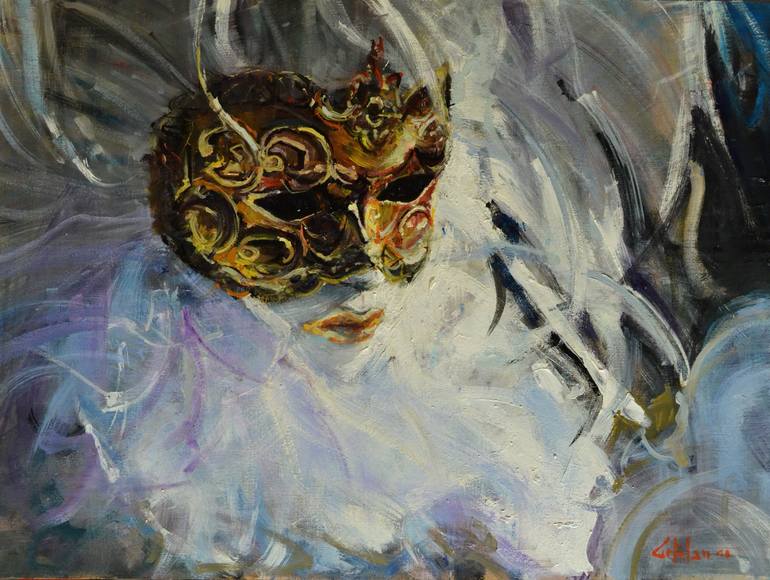
It is said that the Carnival of Venice was started from a victory of the "Serenissima Repubblica" against the Patriarch of Aquileia, Ulrico di Treven in the year 1162. In the honor of this victory, the people started to dance and make reunions in San Marco Square. Apparently, this festival started on that period and became official in the Renaissance.[1] In the seventeenth century, the baroque carnival was a way to save the prestigious image of Venice in the world.[2] It was very famous during the eighteenth century.[3] It encouraged licence and pleasure, but it was also used to protect Venetians against the anguish for present time and future.[4] However, under the rule of the King of Austria, the festival was outlawed entirely in 1797 and the use of masks became strictly forbidden. It reappeared gradually in the nineteenth century, but only for short periods and above all for private feasts, where it became an occasion for artistic creations.[5]
After a long absence, the Carnival returned to operate in 1979.[6] The Italian government decided to bring back the history and culture of Venice, and sought to use the traditional Carnival as the centerpiece of its efforts. The redevelopment of the masks began as the pursuit of some Venetian college students for the tourist trade. Today, approximately 3 million visitors come to Venice every year for the Carnival. One of the most important events is the contest for la maschera più bella ("the most beautiful mask") placed at the last weekend of the Carnival and judged by a panel of international costume and fashion designers.](https://images.saatchiart.com/saatchi/19227/art/2082324/additional_0bd4e9f39a446a3a4a4d9596bfa571ab76a0a615-AICC2-22.jpg)
![You just simply pay 20 usd final respect shipping and customs charges.Guaranteed
It is said that the Carnival of Venice was started from a victory of the "Serenissima Repubblica" against the Patriarch of Aquileia, Ulrico di Treven in the year 1162. In the honor of this victory, the people started to dance and make reunions in San Marco Square. Apparently, this festival started on that period and became official in the Renaissance.[1] In the seventeenth century, the baroque carnival was a way to save the prestigious image of Venice in the world.[2] It was very famous during the eighteenth century.[3] It encouraged licence and pleasure, but it was also used to protect Venetians against the anguish for present time and future.[4] However, under the rule of the King of Austria, the festival was outlawed entirely in 1797 and the use of masks became strictly forbidden. It reappeared gradually in the nineteenth century, but only for short periods and above all for private feasts, where it became an occasion for artistic creations.[5]
After a long absence, the Carnival returned to operate in 1979.[6] The Italian government decided to bring back the history and culture of Venice, and sought to use the traditional Carnival as the centerpiece of its efforts. The redevelopment of the masks began as the pursuit of some Venetian college students for the tourist trade. Today, approximately 3 million visitors come to Venice every year for the Carnival. One of the most important events is the contest for la maschera più bella ("the most beautiful mask") placed at the last weekend of the Carnival and judged by a panel of international costume and fashion designers.](https://images.saatchiart.com/saatchi/19227/art/2082324/additional_c0bdd5899428183dac25f066216da590cf70c934-AICC2-22.jpg)
3177 Views
11
View In My Room
Painting, Oil on Wood
Size: 40 W x 30 H x 0.3 D cm
Ships in a Box
€710
Shipping included
14-day satisfaction guarantee
Trustpilot Score
3177 Views
11
Artist Recognition

Featured in the Catalog

Artist featured in a collection
ABOUT THE ARTWORK
DETAILS AND DIMENSIONS
SHIPPING AND RETURNS
You just simply pay 20 usd final respect shipping and customs charges.Guaranteed It is said that the Carnival of Venice was started from a victory of the "Serenissima Repubblica" against the Patriarch of Aquileia, Ulrico di Treven in the year 1162. In the honor of this victory, the people started t...
Year Created:
2008
Subject:
Styles:
Mediums:
Painting, Oil on Wood
Rarity:
One-of-a-kind Artwork
Size:
40 W x 30 H x 0.3 D cm
Ready to Hang:
Not Applicable
Frame:
Not Framed
Authenticity:
Certificate is Included
Packaging:
Ships in a Box
Delivery Cost:
Shipping is included in price.
Delivery Time:
Typically 5-7 business days for domestic shipments, 10-14 business days for international shipments.
Returns:
14-day return policy. Visit our help section for more information.
Handling:
Ships in a box. Artists are responsible for packaging and adhering to Saatchi Art’s packaging guidelines.
Ships From:
Argentina.
Customs:
Shipments from Argentina may experience delays due to country's regulations for exporting valuable artworks.
Need more information?
Need more information?

Marco Ortolan
Argentina
“For me, the creative process is a constant search for works that are not only perceived but felt. I believe the primary function of art is to transmit sensitivity and evoke sensations, establishing an emotional bridge with those who contemplate it. Once the work is created, art becomes an open space where interpretation is always a vital and subjective act, enriching the aesthetic experience for each individual.” Marco Ortolan – Architect and Visual Artist Trained in the plastic arts since 1985 at the Academy of Miguel Pérez Macías, Marco developed a strong foundation in drawing and painting, influenced by the Italian Renaissance and French Impressionism. Over time, he incorporated ballpoint pen into his practice, refining a technique that blends precision, gesture, and expressive linework. His body of work moves between two complementary languages: oil painting and ballpoint pen drawing, often enhanced with ink. The central themes—human connection, emotional depth, and urban presence—are approached with a quiet, structured, and introspective gaze. Marco’s oil paintings are known for their dense, atmospheric compositions. Using a restrained palette of blacks, greys, deep blues, and warm accents, he creates scenes that feel suspended in time: underwater moments, silent cityscapes, and gestures caught mid-motion. Color is used sparingly and intentionally, turning the canvas into a space of emotional tension. Works such as *Still the Water*, *Kissing Underwater*, *NYC Night*, and *Lovers* reflect this exploration of what remains unspoken. In parallel, his drawings on paper offer a more intimate and direct approach. Executed in ballpoint pen and occasionally touched with ink, these pieces reveal a meditative, deliberate linework. Each stroke is precise, each shadow carefully built. The drawings revisit similar themes—portraits, love, music, identity—but from a quieter, more personal angle. Notable works include *The Model*, *Loving You*, *Jazz (Charlie Parker)*, and *AFRICA*. What unites both series is a clear intention: to create spaces of connection. Marco’s works don’t seek to explain—they invite reflection. His style balances emotion with structure, graphic clarity with painterly depth, forming a visual language that speaks through simplicity, silence, and restraint. For a deeper look into his creative process and philosophy, you can watch the Interview with Marco Ortolan (https://www.youtube.
Artist Recognition
Featured in Saatchi Art's printed catalog, sent to thousands of art collectors
Artist featured by Saatchi Art in a collection
Why Saatchi Art?
Thousands of
5-Star Reviews
We deliver world-class customer service to all of our art buyers.
Global Selection of Original Art
Explore an unparalleled artwork selection from around the world.
Satisfaction Guaranteed
Our 14-day satisfaction guarantee allows you to buy with confidence.
Support Emerging Artists
We pay our artists more on every sale than other galleries.