
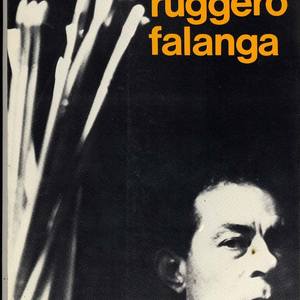
Ruggero Falanga
Milano, Lombardia, Italy
Ruggero Falanga was born in Taormina on 3rd December, 1914, in a modest Southern family. Soon after ...
About the artist
Ruggero Falanga
Joined In 2015
(1 Follower)
About the artist
Ruggero Falanga
Joined In 2015
(1 Follower)
ABOUT
EDUCATION
EXHIBITIONS
Ruggero Falanga was born in Taormina on 3rd December, 1914, in a modest Southern family. Soon after Ruggero’s birth his father had migrated to the United States to seek his fortune there, but had no luck. He was to return only after the end of World War II, following a mining accident.
His father’s departure placed the burden of the family on the shoulders of his mother. She earned money as an embroideress – an art at which she excelled – but it was hardly remunerative. Despite all kinds of difficulties and in the face of gossip, Ruggero’s mother, in a firm, poised and serene manner, managed to preserve the peace and reputation of her family. Ruggero worshipped her and it was to her that he was to turn for inspiration. The cycle of the “maternities” was to be one of the most important periods of his production. At his mother’s death in 1961, we was overcome with grief. He felt in a barren world – his father having died the previous year – and his outlook on life became even more disconsolate and dramatic. It was to be in that period that his art would reach the depths of exasperation; black became the dominant colour. The walls of his studio were entirely covered with images of grief, with human larvae, the symbol of existential ...
Ruggero Falanga, having spent the earlier years of his life at Taormina and Messina – where he was a tailor’s apprentice – then went to Turin, in 1935. There he made a living working for a tailor and at the same time he attended evening classes in the art school where he received his Liceo Artistico diploma. Then, thanks to a scholarship, he joined the Accademia Albertina, whose director was, then Felice Casorati. During the latter part of the war, he joined the resistance movement. It was immediately after the war that the urge to paint exploded within him. Falanga sums up his experiences up to that point by stating, “ Nine years of hard relevant work which allowed me – after I had obtained my diploma – to tackle seriously the art of painting, to which I had decided to devote my life” (1). It was a radical and final choice.
Falanga settled down in the Brera Quarter in 1959, living in a studio that had belonged to Tranquillo Cremona.
(1) Letter to a friend of 3rd January 1962
Galleria Gissi, Torino 1947 Mostra Monografica
Galleria Gissi, Torino 1950 Mostra Monografica
Galleria San Fedele, Milano 1960 Mostra Monografica
Galleria Il Milione, Milano 1961 Mostra Monografica
Galleria San Fedele, Milano1963 Mostra Collettiva
Galleria Sant'Agostino Torino 1968 Mostra Collettiva
Galleria San edele, Milano, 1969 Mostra Monografica
Palazzo Strozzi, Firenze, 1978 Mostra Monografica
Ex Chiesa Sant'Agostino, Taormina 1986 Mostra Monografica
Galleria Comunale D'Arte di Cagliari, Cagliari, 1988 Mostra Monografica
Casa Chironi, Nuoro, 2007 Mostra Retrospettiva