

0
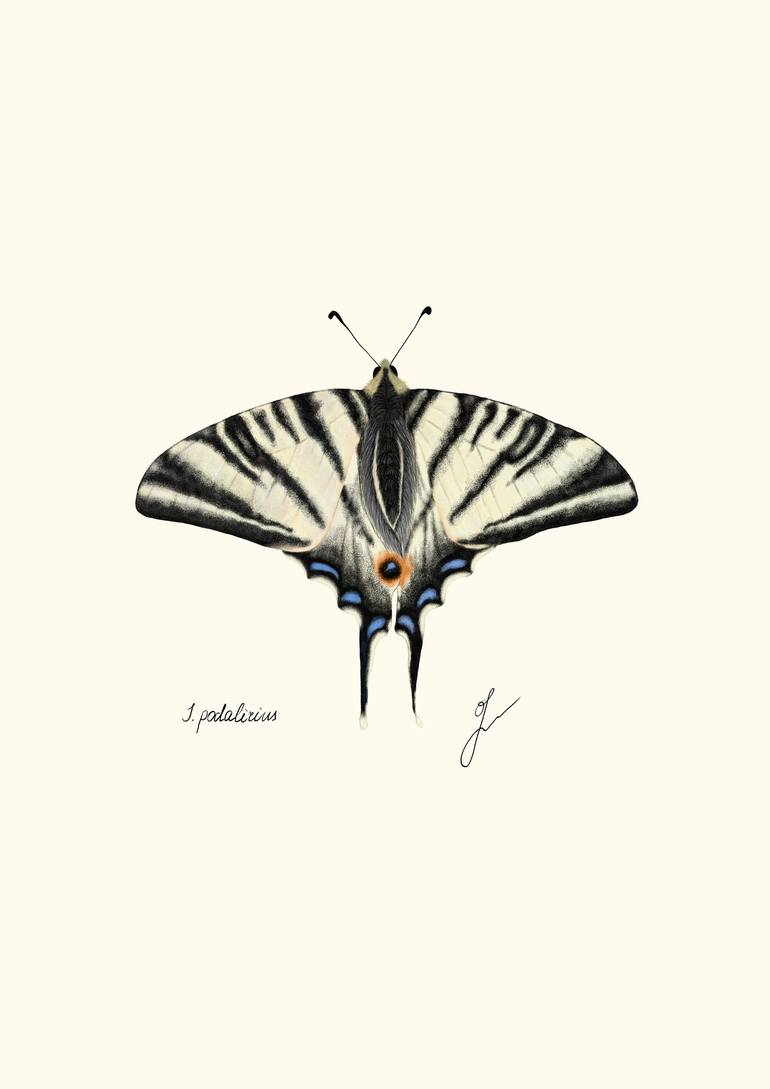
"Iphiclides (Scarce Swallowtail) Entomological Illustration Print" Fine Art Print
$48
Material
- 100% cotton, acid-free, museum quality paper
- Printed with archival pigmented inks
- Has a 2"-3" white border with matte finish
Size
Frame
Archival-grade Materials
Fade-resistant Inks
Professionally Printed
ABOUT THE ARTWORK
DETAILS AND DIMENSIONS
SHIPPING AND RETURNS
Iphiclides podalirius, the scarce swallowtail, carrying the longest tail streamers of any European butterfly. It glides on them, sailing on a current without beating its wings, which is why it is also called the sail swallowtail. The English name is a British accident: it is only a rare migrant to B...
Year Created:
2026
Subject:
Medium:
Print, Giclee on Fine Art Paper
Rarity:
Open Edition
Size:
9 W x 12 H x 0.1 D in
Ready to Hang:
No
Frame:
Not Framed
Packaging:
Ships Rolled in a Tube
Delivery Cost:
Calculated at checkout.
Delivery Time:
Typically 5-7 business days for domestic shipments, 10-14 business days for international shipments.
Returns:
All Open Edition prints are final sale items and ineligible for returns. Visit our help section for more information.
Handling:
Ships rolled in a tube. Art prints are packaged and shipped by our printing partner.
Ships From:
Printing facility in California.
Need more information?
Need more information?

Botanical illustration has been documenting the natural world for 300 years. It has never looked better on a living room wall.
My studio is on Lake Como, Italy, where the botanical tradition runs deep — from the Roman-era lemon gardens of the lakeside villas to the mountain meadows above the lake where alpine plants and butterflies have been documented by naturalists for centuries. I work from that landscape, and I work the old way: observe first, understand the structure, then draw.
I came to this through admiration — for Ehret's precision, Redouté's feeling for light, Merian's insistence on showing the living insect alongside the living plant. I try to follow what they taught. The tradition is the method.
Each illustration begins with a specific organism. Paeonia lactiflora 'Sarah Bernhardt', whose hundreds of petals arrange themselves in a precise geometric spiral that must be understood before it can be drawn convincingly. Papilio machaon, the Old World swallowtail, whose wings are semi-transparent in a way that demands a completely different approach from opaque-winged subjects. Amanita muscaria, whose white warts are fragments of the veil that enclosed the young mushroom before it pushed through the soil. The subject determines the technique.
These are digital illustrations, made by a human artist using digital tools, in the method and aesthetic of 18th-century observational natural history. The "digital" is the medium; the methodology is the same Ehret used in the 1730s when he worked from living plants in George Clifford's garden — direct observation, structural understanding, accurate colour, diagnostic precision. Each piece is then produced as a Digital Pigment Print on Fine Art Paper, to archival museum standards — the same quality used by major botanical gardens for their collection reproductions. They are designed to be lived with.
Behind every illustration is a body of research, published in full on my studio website — botanical illustration history, plant symbolism, and the natural history of every species I draw. Selected works have been shown internationally, from indie galleries to museum exhibitions, in Milan, Tokyo and beyond; the full list is on the Exhibitions tab.
I am also the author of The Living Canvas: A Journey Through Botanical Art, History and Modern Life (462 pages). Hand-signed editions with certificates of authenticity are available directly at my Lake Como studio.
Why Saatchi Art?
Thousands of
5-Star Reviews
We deliver world-class customer service to all of our art buyers.
Global Selection of Original Art
Explore an unparalleled artwork selection from around the world.
Satisfaction Guaranteed
Our 14-day satisfaction guarantee allows you to buy with confidence.
Support Emerging Artists
We pay our artists more on every sale than other galleries.